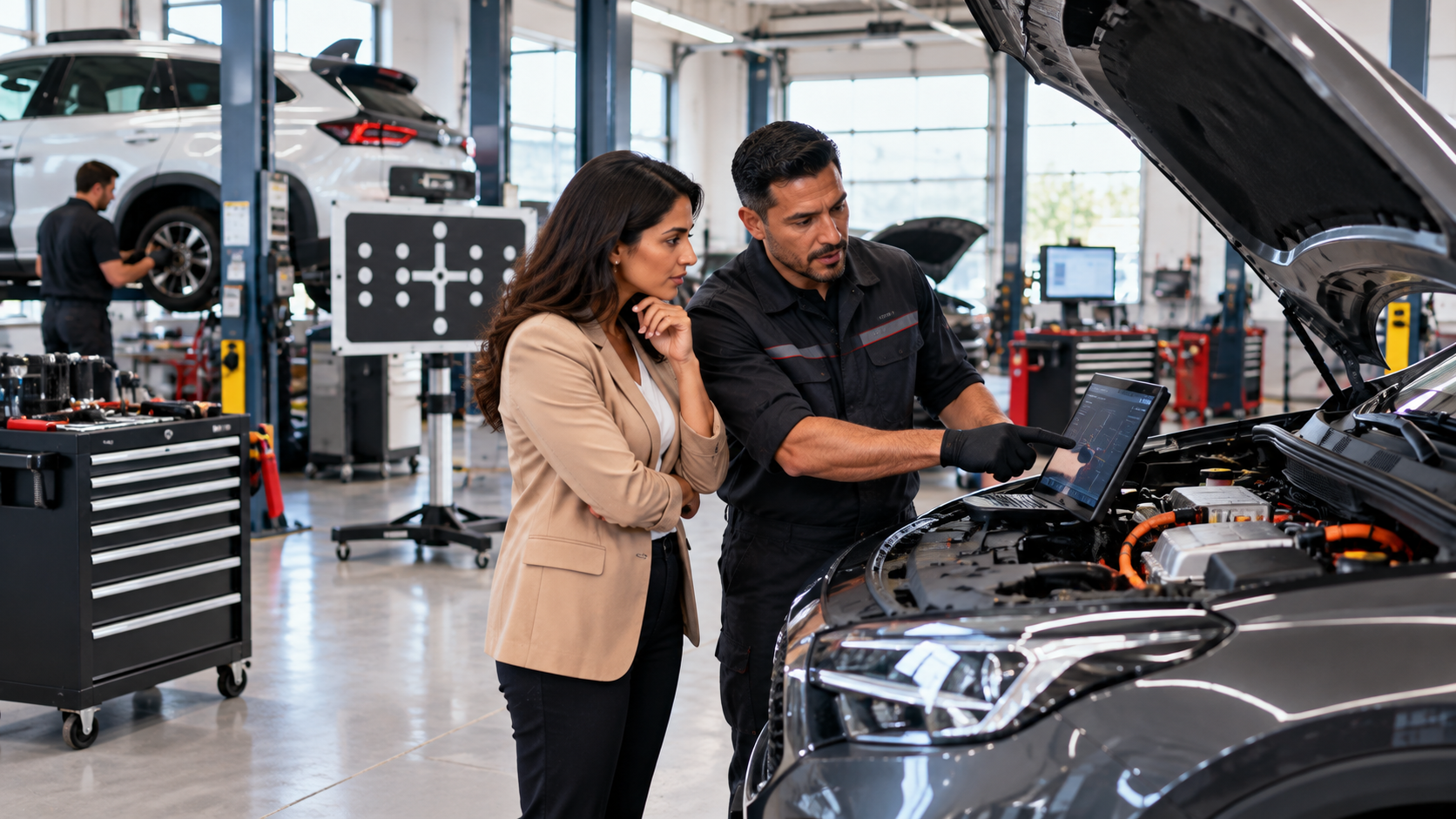
If you are researching how to buy an auto repair business in Canada, focus first on the operating system behind the workshop. A full parking lot and busy service bays can look attractive, but the real value is in repeat customers, technician productivity, labour gross profit, parts margins, equipment condition, diagnostic capability, lease security and the ability to keep skilled staff after ownership changes.
Canada has a large and fragmented automotive repair sector. Innovation, Science and Economic Development Canada's 2025 industry statistics show 25,037 employer establishments and another 23,576 non-employer or indeterminate establishments in automotive repair and maintenance. That fragmentation creates acquisition opportunities, but it also means buyers must compare individual shops carefully rather than assuming one business represents the whole sector.
The sector is also changing quickly. AIA Canada has highlighted continuing technician shortages and the growing importance of ADAS, connected diagnostics, hybrid and electric-vehicle skills. A shop that is profitable today but underinvested in people, training or technology may require significant capital after closing.
1. Decide what kind of automotive business you actually want
“Auto repair” can describe very different businesses. General mechanical shops, transmission specialists, tire shops, collision centres, diesel specialists, fleet-maintenance shops and European or luxury specialists can have different staffing, equipment, margins and regulatory requirements.
Before contacting sellers, define your acquisition criteria:
- Province, city and maximum geographic radius.
- General mechanical, specialty repair, tires, collision, fleet or another model.
- Maximum purchase price and working-capital reserve.
- Owner-operated versus manager-run shop.
- Minimum revenue and normalized owner earnings.
- Minimum number of productive service bays.
- Required technician depth and certifications.
- Whether the real estate is leased or included.
- Acceptable exposure to one fleet or commercial customer.
A clear acquisition profile helps you reject shops that look busy but do not match your capital, experience or management plan.
You can begin by browsing automotive repair businesses for sale in Canada and comparing location, asking price, staffing and disclosed financial information.
2. Understand what makes an auto repair shop valuable
Auto repair businesses are usually valued primarily from sustainable cash flow, but the quality of that cash flow matters as much as the number itself.
Strong shops often have:
- A stable base of repeat customers.
- Experienced technicians who are likely to remain after a sale.
- Healthy labour rates and gross profit.
- Efficient bay utilization.
- Good online reviews and local reputation.
- Modern diagnostic equipment and software access.
- Diversified customer relationships.
- A lease long enough to support the purchase price.
- Documented processes rather than owner-held knowledge.
Weak shops may have similar revenue but much lower transferable value because the owner is the lead technician, service advisor, estimator and customer relationship manager all at once.
3. Rebuild the financials before you discuss price
Do not accept the seller's stated “cash flow” without verification. Auto repair businesses can have owner add-backs, family payroll, personal vehicles, tool purchases, unusual parts purchases or one-time fleet jobs that distort normalized earnings.
Ask your accountant to review enough evidence to reconcile performance, including:
- Corporate or business tax returns for multiple years.
- Historical and year-to-date profit-and-loss statements.
- Bank statements and merchant-processing records.
- Shop-management software reports.
- Parts-purchase records and supplier statements.
- Payroll reports and technician compensation.
- GST/HST filings.
- Fleet or commercial customer invoices.
- Rent, utilities and insurance costs.
- Evidence supporting claimed owner add-backs.
Then normalize the earnings for your ownership model. If the seller produces 35 billable hours a week and you will hire a replacement technician or service manager, that replacement cost belongs in your model.
4. Separate labour economics from parts economics
A repair shop can show strong total revenue while underperforming operationally. Analyse labour and parts separately.
Key metrics to investigate include:
- Effective labour rate.
- Posted door rate.
- Technician billed hours versus paid hours.
- Labour gross profit.
- Parts gross profit.
- Average repair order.
- Car count.
- Estimate approval rate.
- Comeback or warranty-work rate.
Two shops with identical annual sales can have very different economics if one generates disciplined labour productivity and parts margins while the other depends on low-margin work and owner labour.
5. Treat technician retention as a major acquisition risk
Skilled technicians are often one of the most valuable assets in an automotive repair acquisition, even though they do not appear on the balance sheet.
AIA Canada continues to identify labour shortages and technician turnover as major challenges across the auto care sector. That makes staff due diligence particularly important for buyers.
Review:
- Technician tenure.
- Hourly, salary or flat-rate compensation.
- Bonus structures.
- Benefits and vacation.
- Certification levels.
- Specialist skills.
- Apprentice pipeline.
- Tool ownership.
- Recent turnover.
Do not assume technicians will stay because the seller says they are “loyal.” Where appropriate and lawful, plan communication, retention incentives and transition meetings around closing.
6. Check trade certification and provincial requirements
Automotive Service Technician is a Red Seal trade across Canada. The Red Seal occupational standard now includes conventional mechanical work as well as hybrid and electric vehicles, electronics and advanced driver assistance systems.
However, apprenticeship and trade-certification rules are administered by provinces and territories, and implementation can vary. Some provinces also have specific licensing or inspection-centre requirements for certain services.
Before buying, confirm:
- Which technicians hold required provincial trade certificates.
- Which staff have Red Seal endorsements.
- Whether apprentices are properly registered.
- Whether the shop holds inspection, emissions or other approvals.
- Whether those approvals transfer after a change of ownership.
If vehicle inspections are an important revenue stream, verify the exact approval rules directly with the relevant provincial authority.
7. Inspect every major piece of equipment before assigning value to it
An automotive shop can contain hundreds of thousands of dollars in lifts, alignment equipment, scanners, tire machines, compressors, specialty tools and shop infrastructure. The seller's asset list does not tell you condition or remaining useful life.
Inspect major assets such as:
- Vehicle lifts and hoists.
- Wheel alignment equipment.
- Tire changers and balancers.
- Diagnostic scanners.
- ADAS calibration equipment.
- Air compressors.
- Brake lathes and specialty machines.
- Shop-management hardware.
- Waste-oil systems.
- EV and high-voltage safety equipment.
Determine which assets are owned, financed, leased or personally owned by technicians. Obtain service records and identify upcoming replacement costs.
8. Verify the shop is ready for newer vehicle technology
Vehicle technology is changing the economics of repair. AIA Canada has specifically highlighted ADAS, connected diagnostics, electrification and software-related service requirements as areas where shops need new skills and equipment.
Ask:
- Can the shop service hybrid and electric vehicles safely?
- Can technicians diagnose modern networked vehicle systems?
- Does the shop have OEM service-information access where required?
- Can it perform or outsource ADAS calibration?
- Are technicians receiving ongoing training?
- What capital expenditure is needed over the next three years?
A shop that has delayed technology investment may still be profitable today, but the buyer should not pay a premium and then immediately fund a major modernization program.
9. Review the lease and physical property carefully
Repair shops have location-specific infrastructure that can make relocation expensive. Hoists, exhaust ventilation, compressed air, oil storage, drains, power supply and parking can all be difficult to reproduce somewhere else.
Have counsel review:
- Remaining lease term and renewal options.
- Assignment requirements.
- Rent increases.
- Repair obligations.
- Environmental clauses.
- Use restrictions.
- Parking and vehicle-storage rights.
- Signage rights.
- Responsibility for lifts and leasehold improvements.
If real estate is included in the transaction, treat the property valuation and environmental investigation as separate workstreams from the operating-business valuation.
10. Environmental due diligence is not optional
Automotive repair operations handle used oil, filters, coolants, batteries, solvents and other materials that can create environmental liabilities if they have been stored or disposed of improperly.
Environment and Climate Change Canada notes that provinces and territories maintain controls over used crankcase oil and prohibit improper disposal to land, landfills and sewers. Actual requirements are jurisdiction-specific.
Depending on the property and transaction, consider reviewing:
- Used-oil storage.
- Floor drains and separators.
- Underground or above-ground tanks.
- Historical spills.
- Waste manifests or recycler records.
- Battery and tire disposal.
- Solvent and chemical storage.
- Past environmental reports.
If there is any concern about historical contamination, obtain advice from an environmental professional before closing. Cleanup liability can easily exceed the value of the business itself.
11. Analyse customer concentration and fleet contracts
Commercial and fleet work can be valuable because it creates repeat volume, but it can also create concentration risk.
Review the top customers by revenue and gross profit. For fleet accounts, check:
- Contract term.
- Pricing arrangements.
- Payment terms.
- Service-level requirements.
- Transfer or change-of-control clauses.
- Customer tenure.
If one fleet customer represents 25% of shop revenue, losing that account after the sale can materially change the economics. Confirm relationships rather than assuming they transfer automatically.
12. Review parts suppliers and purchasing terms
Parts economics can materially affect gross profit. Ask whether current pricing depends on volume, buying groups, franchise arrangements, rebates or personal relationships with the owner.
Identify:
- Top suppliers.
- Credit limits.
- Discount tiers.
- Rebate programs.
- Return privileges.
- Warranty reimbursement procedures.
- Supplier concentration.
Confirm which commercial terms will continue for the buyer rather than modelling future margins from the seller's historical discounts without verification.
13. Check the customer database and reputation
For a local repair business, the customer list, service history and reputation can be among the most valuable intangible assets.
Review:
- Customer count.
- Repeat-visit rate.
- Average repair order.
- Vehicle count per household.
- Google rating and review trend.
- Unresolved complaints.
- Warranty obligations.
- Marketing opt-ins and privacy compliance.
A business with strong repeat demand and documented service history can be more transferable than one driven primarily by the seller's personal relationships.
14. Build a Canadian auto repair acquisition checklist
| Area | What to verify | Why it matters |
|---|---|---|
| Financial | Tax returns, P&Ls, bank, software and GST/HST records | Confirms sustainable cash flow |
| Labour | Technician pay, productivity, certifications and turnover | Protects capacity and customer service |
| Equipment | Ownership, condition, service history and replacement cost | Identifies hidden capital expenditure |
| Technology | ADAS, EV, diagnostics and software readiness | Shows whether the shop can service newer vehicles |
| Lease | Term, assignment, rent, parking and environmental clauses | Protects the operating location |
| Environment | Used oil, tanks, drains, spills and waste records | Reduces contamination liability |
| Customers | Repeat business, fleets, concentration and reviews | Measures revenue durability |
| Suppliers | Parts pricing, credit, rebates and transferability | Protects gross margin |
| Regulatory | Trade credentials, inspection approvals and provincial rules | Ensures legal operating continuity |
15. Structure the offer around the risks you still need to verify
A purchase offer should protect you while major facts remain unverified.
Depending on the transaction, conditions may include:
- Satisfactory financial and legal due diligence.
- Financing approval.
- Acceptable lease assignment or property review.
- Equipment inspection.
- Environmental review.
- Confirmation of key fleet accounts.
- Technician retention planning.
- Transfer or re-approval of inspection licences.
- Agreed inventory and parts valuation.
- Training and transition support.
Have a Canadian business lawyer and accountant review the structure before you commit substantial funds.
16. Plan the first 90 days before closing
Repair shops depend on continuity. The worst transition is one where technicians, customers or suppliers discover the ownership change through rumours.
Prepare a transition plan for:
- Staff communication.
- Customer communication.
- Banking and merchant processing.
- Supplier accounts.
- Shop-management software.
- Parts inventory.
- Fleet customers.
- Insurance.
- Licences and inspection approvals.
- Waste-service providers.
- Equipment maintenance.
Stabilize the shop before making major changes. Your first goal is to preserve technician confidence, customer trust and service capacity while verifying that actual post-closing results match your acquisition model.
Red flags when buying an auto repair business
- Seller earnings cannot be reconciled to tax, bank and shop-management records.
- The owner is the only senior technician or service advisor.
- Several key technicians intend to leave.
- Major equipment is ageing, financed or personally owned.
- The shop has no realistic plan for ADAS, EV or advanced diagnostics.
- One fleet customer represents a large share of revenue.
- The lease is short or difficult to assign.
- Waste-oil, tank or spill records are incomplete.
- Inspection or licensing approvals may not transfer.
- Parts margins depend on discounts that are not available to a new owner.
- Online reviews have deteriorated while the seller is marketing the business for sale.
Frequently asked questions
How do I buy an auto repair business in Canada?
Define the shop model you want, compare multiple opportunities, verify the financial records, analyse technician productivity and retention, inspect equipment, review the lease and environmental history, confirm provincial certification or inspection requirements, then negotiate a conditional offer and complete professional due diligence.
How many automotive repair businesses are there in Canada?
ISED's 2025 Canadian Industry Statistics reports 25,037 employer establishments and 23,576 non-employer or indeterminate establishments in automotive repair and maintenance, showing how fragmented the sector is.
Is Automotive Service Technician a Red Seal trade?
Yes. Automotive Service Technician is designated as a Red Seal trade across Canada. Provincial and territorial apprenticeship authorities remain responsible for their own certification and apprenticeship requirements.
What equipment should I inspect before buying a repair shop?
Inspect vehicle lifts, alignment systems, diagnostic scanners, tire equipment, compressors, ADAS tools, EV safety equipment and other major shop assets. Confirm ownership, maintenance history and expected replacement cost.
Why is environmental due diligence important for an auto repair shop?
Repair shops handle used oil, batteries, coolants, solvents and other materials that can contaminate a property if mishandled. Historical contamination can create significant cleanup costs, so buyers should review environmental records and obtain professional advice where needed.
How important is technician retention?
Extremely important. Skilled technicians directly determine shop capacity and customer service. A profitable business can deteriorate quickly if key technicians leave after the acquisition.
Before you make an offer
A strong auto repair acquisition is not simply a busy shop. It is a business where the buyer can verify cash flow, retain skilled technicians, trust the equipment, secure the premises, understand environmental exposure and continue serving modern vehicles profitably after ownership changes.
Compare several shops and be prepared to walk away when the earnings, staff, equipment or property risks do not justify the price.
Sources and further reading
- Innovation, Science and Economic Development Canada — Automotive repair and maintenance industry statistics
- Statistics Canada — Repair and maintenance services summary statistics
- Red Seal Program — Automotive Service Technician
- AIA Canada — Automotive technology and skill-readiness gap
- AIA Canada — Technician retention and workforce challenges
- Environment and Climate Change Canada — Used crankcase oil risk management
- BusinessesForSale — Auto repair businesses for sale in Canada
- BizBuySell — Auto repair valuation benchmarks for general market context